Free Worldwide Shipping • Free Custom Rug Design from Your Dream Artwork • Free Consultation with Our Rug Experts • Premium Handmade Quality • Fully Custom Sizes and Colors Available
Free Worldwide Shipping • Free Custom Rug Design from Your Dream Artwork • Free Consultation with Our Rug Experts • Premium Handmade Quality • Fully Custom Sizes and Colors Available

Hand-Knotted vs Hand-Tufted vs Hand-Loom Rugs: A Complete Buyer's Guide
If you’ve ever shopped for a handmade rug, you’ve probably come across three terms that sound similar but mean very different things: hand-knotted, hand-tufted, and hand-loom. The construction method affects everything — how long the rug takes to make, how it feels underfoot, how long it lasts, and of course, the price.
At Hali Rug Company, we’ve been making rugs in Bhadohi since 1997, and all three of these techniques are produced by our artisans every day. Here’s an honest breakdown to help you choose the right one for your home or project.
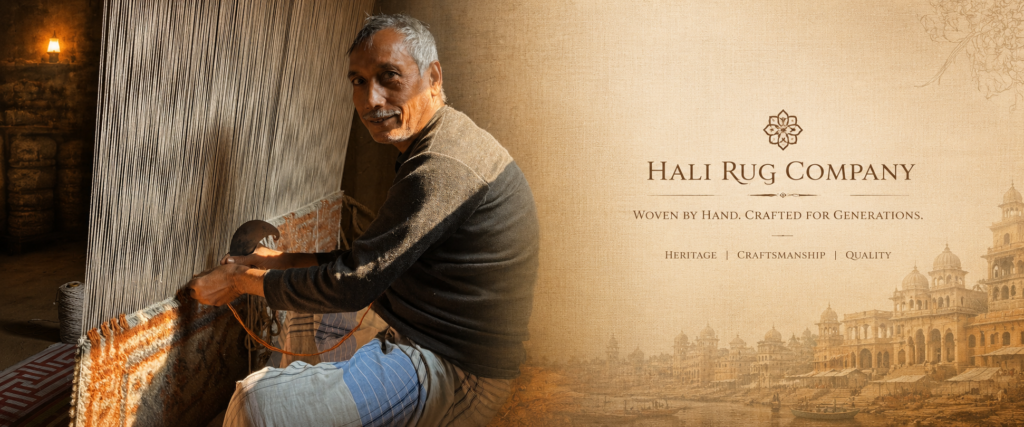
1. Hand-Knotted Rugs: The Heirloom Standard
Hand-knotted rugs are the oldest and most labor-intensive form of rug making. Each rug is created on a vertical loom where artisans tie individual knots — sometimes hundreds of thousands, even millions — around the warp threads, one at a time, by hand.
How it’s made: A skilled weaver ties each knot manually, then trims and packs each row before moving to the next. A single 8×10 ft hand-knotted rug can take anywhere from 4 to 12 months to complete, depending on the knot count and design complexity.
Best for:
- Buyers looking for a true heirloom piece
- Living rooms, formal spaces, bedrooms
- Anyone who values craftsmanship and long-term investment
Pros:
- Lifespan of 50–100+ years with proper care
- The back of the rug clearly shows the design (a key sign of authenticity)
- Higher knot counts allow for intricate, detailed patterns
- Genuinely appreciates in value over time
Things to know:
- The highest price point of the three
- Longer production lead time
- Best suited for buyers who understand they’re paying for craftsmanship, not just floor covering
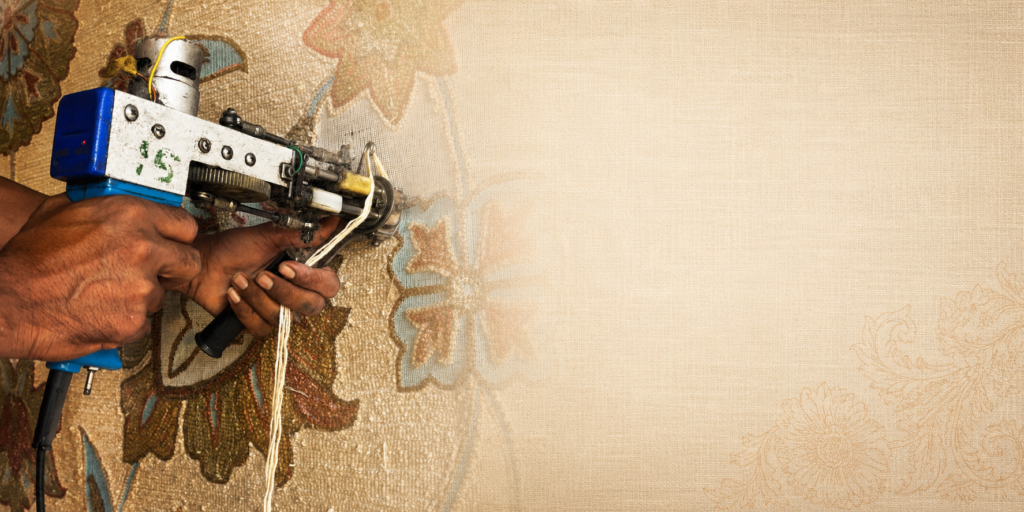
2. Hand-Tufted Rugs: Style at a Better Price
Hand-tufted rugs offer a great middle ground. Instead of tying individual knots, artisans use a hand-operated tufting gun to push yarn through a stretched canvas backing following a pre-drawn design.
How it’s made: The design is sketched onto the canvas, and the tufting tool pushes loops of yarn through. Once tufting is complete, a secondary backing (usually cotton) is glued on, and the surface is sheared to create the final pile. A hand-tufted 8×10 ft rug typically takes 3–6 weeks.
Best for:
- Buyers who want a designer look without the hand-knotted price tag
- Bedrooms, dining rooms, lower-traffic living spaces
- Designers working within a budget but who still want a custom design
Pros:
- Significantly more affordable than hand-knotted
- Faster turnaround for custom orders
- Easier to produce thick, plush piles
- Excellent design flexibility — almost any pattern can be tufted
Things to know:
- Lifespan typically 7–15 years
- The backing is glued, not woven, so the rug shouldn’t be soaked when cleaning
- The back of the rug shows fabric, not the design
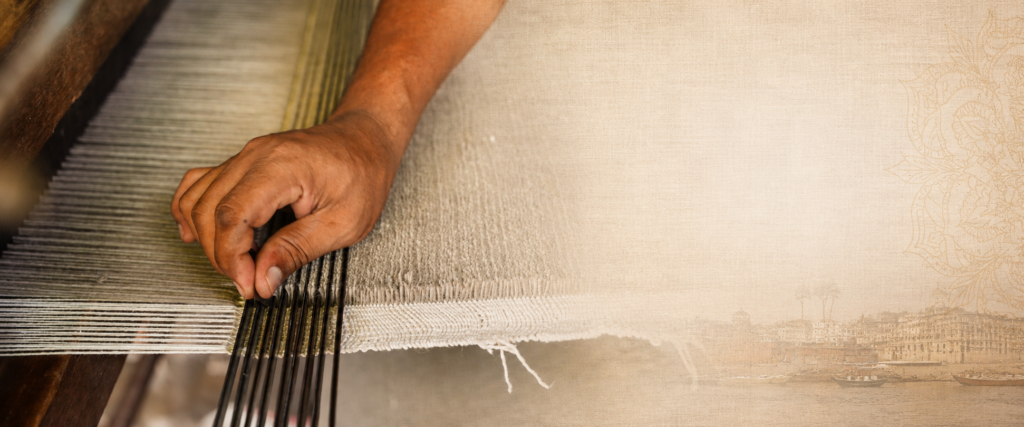
3. Hand-Loom Rugs: Modern and Versatile
Hand-loom rugs are woven on a traditional pit loom or frame loom, where the weaver passes weft yarns through the warp by hand. This is a faster technique than knotting but still entirely manual.
How it’s made: The weaver sits at a loom and weaves the rug row by row using a shuttle. The pile is then sheared after weaving. An 8×10 ft hand-loom rug usually takes 2–4 weeks.
Best for:
- Contemporary and minimalist interiors
- High-traffic areas like hallways and family rooms
- Buyers who want a handmade rug without traditional patterns
Pros:
- More affordable than hand-knotted
- Durable and dense construction
- Clean, modern aesthetic — works well in solid colors and simple patterns
- Faster production than knotted rugs
Things to know:
- Intricate, multi-color patterns are harder to achieve than with knotting or tufting
- Lifespan of 15–25 years with proper care
- Best suited for solid colors, stripes, and contemporary designs
How to Choose
Ask yourself three questions:
- What’s the room? Formal living rooms and bedrooms justify hand-knotted; family rooms and hallways are well-served by hand-loom; designer accents and budget-friendly statement pieces are perfect for hand-tufted.
- How long do you want it to last? If you want something to pass down, hand-knotted is the only real answer. For 10–20 years of beautiful use, hand-tufted or hand-loom both work well.
- What’s your design vision? Intricate Persian-style patterns need hand-knotting. Bold contemporary designs work great as hand-tufted. Clean modern solids and simple geometrics are perfect for hand-loom.
A Final Note
There’s no “best” construction — only the best one for your space, budget, and goals. We make all three at Hali Rug Company because each one has a place. A young couple furnishing their first home might be better served by a beautiful hand-tufted piece, while a designer working on a luxury hotel lobby will want the gravitas of hand-knotted.
If you’re not sure which is right for your project, we’re happy to help. Our team has been guiding buyers — from individual homeowners to global hospitality brands — for over 90 years.
Hali Rug Company is a family-owned manufacturer and exporter of handmade rugs based in Bhadohi, India. Founded in 1997, we produce hand-knotted, hand-tufted, hand-loom, flat weave, and other rug styles in wool, silk, bamboo silk, and mohair, with free worldwide shipping.